Posts

Writing Women's Lives

 Word Count: 275 Writing Women's Lives      The documentary, Writing Women's Lives , exemplifies all the experiences women writers draw from to create their works. Each of the women came from different backgrounds that lead to their works being simultaneously unique and relatable. This documentary also showed the direct effect of the feminist movement on art during this time. One can see the drastic shift from previous works by women before the feminist movement and the ones born out of feminism. This new age of writing means the reader must adapt the lens they read certain works through. Older pieces are now seen as feminist works, even though the values are not similar to the ones the author held. This brings into consideration a new question: should the pieces be used as feminist propaganda, or should they be read as the author intended? Basically, is the reader allowed to find extraneous meaning from these works? The answer depends on the reader.    ...
Maya Angelou

 Word Count: 254 "Caged Bird" and "Phenomenal Woman" by Maya Angelou     These poems both depict the struggles of Maya Angelou, and how she dealt with them. The first poem, "Caged Bird," describes the feeling of being trapped. She juxtaposes stanzas depicting a free bird flying in the sky with a bird in a cage. This shows what it felt like to be a black woman during this era. She was watching white women excel, especially through the feminist movement, but she was still trapped by her race. The poem states. "his wings were clipped and / his feet are tied / so he opens his throat to sing" (Angelou). The bird's singing represents Angelou writing poetry. It is her way of matching the freedom of everyone else. It is her way of feeling as free as a bird flying.     The second poem, "Phenomenal Woman," shows Angelou's strength. This poem is the first we have read in this class that one can truly see the themes of the feminist movement...

"Harlem Slang"

 Word count: 262 "Harlem Slang" by Zora Neale Hurston "All you did by rolling out early was to stir your stomach up. That made you hunt for more dishes to dirty. the longer you slept, the less you had to eat" (Hurston, 1). "Go ahead, Bedbug! Touch me! And I'll holler like a pretty white woman!" (Hurston, 6)     These quotations describe society during the time when Zora Neale Hurston wrote "Harlem Slang." The first quotation speaks to the struggles of poverty. The lower classes knew how to last the day by eating as little as possible because food was too much money for some. Here, Hurston describes the technique where people attempt to lay in bed for as long as possible in the morning so they can eat fewer meals. Later in the story, the narrator mentions that Sweet Black had not eaten since the day before. They were so desperate for sustenance that men prostituted themselves to women. This is also almost unheard of change in the power dynamic...

"The Yellow Wallpaper"

 Word Count: 254 "The Yellow Wallpaper" by Charlotte Perkins Gilman "John does not know how much I really suffer. He knows there is no reason to suffer, and that satisfies him" (Gilman, 3). "It is fortunate Mary is so good with the baby. Such a dear baby! And yet I cannot be with him, it makes me so nervous" (Gilman, 3). "And she is all the time trying to climb through. But nobody could climb through that pattern - it strangles so" (Gilman, 8).     "The Yellow Wallpaper" by Charlotte Perkins Gilman is a short story about a woman with severe Postpartum Depression. This first quote demonstrates that no one, even her husband, understands what she is going through. They, at this time, do not think giving birth to a child is a reason to suffer, and it is possible that if they know she was suffering from the baby, they would think her more "insane." The second quote illustrates that her illness, which her husband has moved her away ...

Mrs. Dalloway

 Word Count: 279 Mrs. Dalloway      I chose the scene when Pete and Clarissa are arguing about their future. Clarissa has chosen not to marry Peter, but instead marry Richard Dalloway. She feels safe with Richard, and he does not have the same extravagant expectations for Clarissa like Peter does. Peter wants her to do more with her life than stay at home and be a mother and wife, but that is not what she wants. This is a direct contrast from the other novels we have read. In these other novels, women want to marry for love and do more with their lives than stay at home. We explicitly see this in The Awakening  by Kate Chopin. In The Awakening , Edna yearns for a life more than what she has been given. We also see the older Mrs. Dalloway contemplate on this point. She wonders if she made the correct decisions when she was younger. This contemplation is very interesting, because she was given other options when she was young, and other young women of the time wer...

The Awakening Part 2

 Word Count: 283 The Awakening  by Kate Chopin "but whatever came, she had resolved never again to belong to another than herself" (Chopin, 80). "I am no longer one of Mr. Pontellier's possessions to dispose of or not. I give myself where I choose" (Chopin, 108).     Both of these quotations demonstrate Edna's revelation or awakening. At the beginning of the novel, she tries to understand these concepts, but she struggles to understand the full meaning of being an individual. I think Edna really wants and yearns to love her husband and to be happy as a wife and mother, but she cannot. The realization that she can never truly be at peace with her life in this situation leads to this conversation with Robert where she divulges her discernment of her wants and needs. Enda sees her relationship with Robert as a relationship of individuals that are equals. This contrasts with her current relationship with her husband where he views her as "a valuable piece o...

The Awakening Part 1

 Word Count: 307 The Awakening  by Kate Chopin "I would give up the unessential; I would give up my money, I would give my life for my children; but I wouldn't give myself" (Chopin, 47). "In short, Mrs. Pontellier was beginning to realize her position in the universe as a human being, and to recognize her relations as an individual to the world within and about her" (Chopin, 13).     The first quotation, I think, is the most interesting concept in the novella. Edna states to her close friend that she would not give herself for her children, but she would give anything else, even her life. This might relate back to the idea that Edna is a bad "mother-woman," but I believe Chopin meant something very different by this. I think this is a statement about individuality. If Edna does not have herself, as in her personality and her individual characteristics, she would have nothing. She would have nothing to give to her children; she could do nothing for them...

Emily Dickinson

Word Count: 271 Emily Dickinson's Poems "Now I knew I lost her -" / "My Life had stood - a Loaded Gun" / "The Poets light but Lamps -" / "I would no paint - a picture -" (Dickinson)     These four poems by Emily Dickinson all contain themes of either art or self-identity. Specifically, "Now I knew I lost her -" and "My life had stood - a Loaded Gun" tackle the topic surrounding identity, and the confusion surrounding the idea. The final two lines of the first stanza of the latter poem mentioned states, "The Owner passed - identified - / And carried Me away" (Dickinson). In the later stanzas of this poem, Dickinson creates a new male identity with which her female persona travels. This relates back to the idea of female writers creating an androgenous personality when writing. The former poem mentioned speaks to the idea of losing one's self and becoming something or someone unrecognizable. The first stanza st...

Silas Marner Part 2

Word Count: 280 Silas Marner  by George Eliot  "The vindication of the loved object is the best balm affection can find words for its wounds: - 'A man must have so much on his mind,' is the belief by which a wife often supports a cheerful face under rough answers and unfeeling words" (Eliot, 135).     This quotation expresses Nancy's thoughts when she soothes herself. It seems that many wives during this time live under the impression that their husbands must always be correct, and any problem that arises is the fault of the woman. While this might not have been true, it is the impression Eliot creates throughout this novel when depicting traditional marriage. The only woman who crosses her husband was Molly, and she dies while trying to expose her unconventional and secret marriage. This directly demonstrates the consequences a woman suffers once defying her husband.      Nancy experiences extreme guilt about her lack of siring a child for her husband...

Silas Marner Part 1

 Word Count: 258 Silas Marner  by George Eliot "To the peasants of old times, the world outside their own direct experience was a region of vagueness and mystery: to their untravelled thought a state of wandering was a conception as dim as the winter life of the swallows that came back with the spring;" (Eliot, 3). "[W]hen he would have to bear the consequences of his father's violent resentment for the wound inflicted on his family pride - would have, perhaps, to turn his back on that hereditary ease and dignity which, after all, was a sort of reason for living," (Eliot, 27).     Both of these quotations provide a description of the society in a small town during the early nineteenth century. The first quotation supplies people's views of outsiders. It lets the reader know how small and confined the people are to their homes. The narrator states that none one really travels during this time, and it was deemed strange if one did. They had no need to see the ...

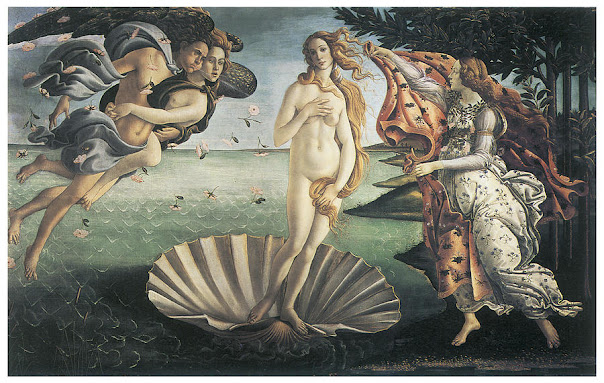
Birth of Venus

Image
"Birth of Venus" by Sandro Botticelli

"In an Artist's Studio"

Word Count: 261 "In an Artist's Studio" by Christina Rossetti "Not as she is, but was when hope shone bright; / Not as she is, but as she fills his dream." (Rossetti)     These lines are the last in the single stanza poem by Christina Rossetti called "In an Artist's Studio." These lines are a commentary on what are actually is - visions of people and no reality. They demonstrate that art is created from within oneself and not from truth. Art is reality that has been twisted and contorted into something else, sometimes more beautiful. This also demonstrates why art is so beautiful - because it is not real. The world is messy and scary, but art does not have to show those parts. Art only shows the serene beauty of the world. Even art that depicts ideas that might show the bad parts of the world, is never as ugly as reality is.     The message of this poem reminds one of The Picture of Dorian Gray  by Oscar Wilde. While "In an Artist's Studio...

"Goblin Market"

Word Count: 301 "Goblin Market" by Christina Rossetti "'For there is no friend like a sister / In calm or stormy weather; / To cheer one on the tedious way, / To fetch one if one goes astray, / To lift one if one totters down, / To strengthen whilst one stands.'" (Rossetti)     This quotation creates the final lines of the poem and it depicts the moral behind this work. Throughout the poem, the narrator repeatedly reminds the audience of Lizzie and Laura's love and loyalty for one another as sisters. Their bond was so strong that when Lizzie witnessed Laura deteriorating from eating the fruit from the goblins, she faces the goblins herself. Luckily, she came out of the situation unscathed and saved her sister, but she knew that she might end up like her sister. The story of Jeanie's life and death scare both the sisters enough to know how dire Laura's situation is and motivate Lizzie to risk her own health to save her sister.      This poem also ...

Lady Audley's Secret

Word Count: 290 Lady Audley's Secret       The scene that I found important in the film  Lady Audley's Secret  is when Lucy states that no aminal being actively hunted accepts its fate. This appears to be conducive to her feelings about her life and situation. She is constantly being chased, or hunted, by someone throughout the entire film. Throughout all of this she never truly gives in. Even at the end of the film when she is taken to a mental institution, she manages to get away and start a completely new life again as she had done once before. It seems as if her former person, beginning with Helen, gets captured by the hunter, but somehow she perseveres and continues on. She never accepts her fate, in fact, she rejects it in a multitude of situations.      Lady Audley wants to be in charge of her own life and destiny. During this time, the fate of a woman rested on her ability to marry well. Because of her past struggles with poverty, she...

Pride and Prejudice Part 2

 Word count: 317     Pride and Prejudice  by Jane Austen "No, Lizzy, let me once in my life feel how much I have been to blame. I am not afraid of being overpowered by the impression. It will pass away seen enough" (Austen, 271) "'My object then ,' replied Darcy, 'was to shew you, by every civility in my power, that I was not so mean as to resent the past; and I hoped to obtain your forgiveness, to lessen your ill opinion, by letting you see that your reproofs had been attended to.'" (Austen, 334)     The first quotation was pronounced by Mr. Bennet after Lydia had eloped with Mr. Wickham. This quotation relays his guilt over his past actions and his realization of his mistakes. His mistakes do not come from action, but, rather, lack of action. At the beginning of the novel, Mr. Bennet finds Lydia and Kitty's antics to be a source of comedy, rather than a cause for concern. When Lydia asks to go with the Regiment, he allows her to because he beli...

"Who Was The Real Jane Austen?"

 Word count: 167 "Who Was The Real Jane Austen?" by Timeline - World History Documentaries and Lucy Worsley      As I knew virtually nothing about Jane Austen's life, "Who Was The Real Jane Austen" was immensely  informative. I had always assumed she had married and found love in the same way the protagonists do in her novels, and I was surprised to find the opposite was true. Austen died as a single woman. She never married, and at one point she was proposed to and accepted, but later she decided against the match. Another surprising fact was that Austen lived in poverty for most of her life, similar to the Bennet's in Pride and Prejudice .      Another interesting point was about her writing and novels. Austen began writing at a very young age, and Pride and Prejudice  was her most popular work while she was alive. However, she made very little money from publishing it. She sold the rights to it and did not make a commission, and she instea...

Pride and Prejudice Part 1

 Word count: 296 Pride and Prejudice  by Jane Austen "Happiness in marriage is entirely a matter of chance" (Austen, 27). "He really believed, that were it not for the inferiority of her connexions, he should be in some danger" (Austen, 53).     The first quotation is pronounced by Charlotte Lucas on the topic of Jane Bennet and Charles Bingly's newly blossoming love. This quotation relays society's view of marriage at the time. Marriage was solely for new connections and property - especially for women. Although this novel focuses mostly on love matches, the reader learns about other, less fortunate matches. For example, Charlotte's match with Mr. Collins is most advantageous for her because she is the eldest in a large family; therefore, she does not have a big dowry for marriage for higher status. This marriage will also allow her younger sisters to "come out" into society sooner so seek husbands. As seen in the second quotations, people of ...

Fantomina

 Word Count: 289 Fantomina  by Eliza Haywood "tis thus our silly, fond, believing Sex are serv'd when they put Faith in Man: So had I been deceiv'd and cheated, had I like the rest believ'd, and sat down mourning in Absence, and vainly waiting recover'd Tendernesses. – How do some Women, (continued she) make their Life a Hell, burning in fruitless Expectations, and dreaming out their Days in Hopes and Fears, then wake at last to all the Horror of Dispair?" (Haywood)     This quotation encapsulates the main character's frustration in Fantomina . It depicts her pain, but also her lovesick stupidity. This quotation came after  Beauplaisir had already become bored with some of her characters, but she still seems surprised he committed the same atrocities with her new persona. She, playing a new role, pursues him repeatedly in hopes he might stay and not get bored, and every time he does, and she is disappointed.  This quotation also relays the fact that she fe...

The Duchess

 Word count: 316 The Duchess The Duke states, "For the life of me I don't understand why women's attire must be so damned complicated." Georgiana replies, "I suppose it's just our way of expressing ourselves." The Duke asks, "Whatever do you mean?" Georgiana replies, "Well, that you have so many ways of expressing yourselves, whereas we must make do with our hats and our dresses, I suppose" (Dibb, 2008) "I am sure you are full of the best intentions, Mr. Fox, but I dare say I would not spend my vote - assuming I had it - on so vague a statement. Either one is free or one is not. The concept of freedom is an absolute. After all, one cannot be moderately dead, moderately loved, or moderately free. It must always remain a matter of either or."       The first quote is dialogue is from the Duke and Georgiana's wedding night. They have this conversation as the Duke undresses her. This scene is immensely powerful. Georgiana ex...

The History of the Nun

 Word Count: 267 The History of the Nun  by Aphra Behn "I could wish, for the prevention of abundance of Mischiefs [Page 7] and Miseries, that Nunneries and Marriages were not to be enter'd into, 'till the Maid, so destin'd, were of a mature Age to make her own Choice; and that Parents would not make use of their justly assum'd Authority to compel their Children" (Behn, 3). "distributing all she had amongst, and for the Use of, the Poor of the Town, especially to the Poor Widows; exhorting daily, the Young, and the Fair, that came perpetually to visit her, never to break a Vow, for that was first the Ruine of her" (Behn, 35).     The first quotation is a sentiment of the narrator stating that she believes guardians of young girls should not decide the fate of their daughters, but rather that their daughters should decide their own fate once they are mature enough. This is what happened to Isabella. While she grows up in the convent, she has time to e...